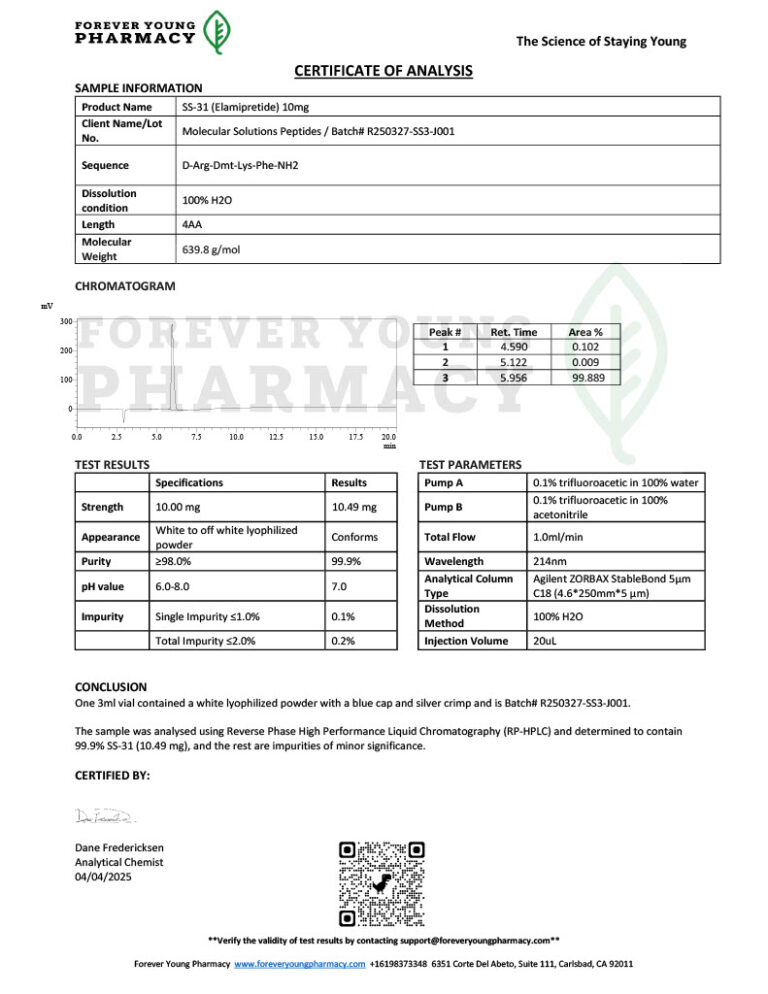
The companion web page on why 99 percent purity issues describes why tiny impurity portions can Research Peptide Store still matter in sensitive in-vitro assays. Along with this peptide testing overview, those pages create the trust-methodology layer behind the product brochure. Peptide screening is effective, but scientists need to review the extent of each approach thoroughly.
What Is Laboratory Validation And Why Is It Critical For Peptides?
We employ GC-MS, ICP-MS, and other approaches to discover contaminations, ensuring item safety and security and regulatory conformity. Peptide sequencing is essential for determining the precise amino acid sequence of peptides, consisting of modifications like phosphorylation or acetylation. Sequencing allows researchers to understand the organic function of the peptide and its interaction with various other particles, assisting in the style of functional peptides for varied applications. The peptide sample is liquified in a suitable solvent and filled into an autosampler.
We give peptide identity verification using mass-based approaches selected for the sample and logical purpose.
Importantly, pureness portions explain chemical structure just-- they do not indicate sterility or organic suitability.
" Mass spectrometry solutions "is the detected substance consistent with the designated peptide identity?
Apex Lab Editorial Team
Each peptide has a different expected molecular weight, so mass confirmation is not a common badge; it is compound-specific proof. For a deeper identity-focused description, see Mass Spectrometry Peptide Confirmation. Identification screening confirms that what was synthesised is actually the desired series.
Many peptide vendors and research laboratories count on a number of well-established logical methods. All items are cost research study, research laboratory, or analytical objectives only, and are except human use. Item descriptions and categorizations do not imply any kind of therapeutic end results. At Chameleon Peptides, every item ships with detailed third-party testing documentation. You can find out more about our logical screening protocols on our screening and high quality web page. A 2016 survey published in Nature discovered that greater than 70% of scientists had actually tried and failed to reproduce another researcher's experiments.
Often Asked Concerns (Faqs) Regarding Laboratory Validation In Peptide Research Study
The pureness of peptides is commonly examined making use of high-performance liquid chromatography (HPLC). HPLC divides peptides based on their communications with a stationary stage, enabling impurities and byproducts to be recognized and quantified. Furthermore, mass spectrometry (MS) can be utilized to confirm the peptide's molecular weight and series, supplying more confirmation of purity by finding contaminants and destruction items. If you have actually ever acquired an artificial peptide for a laboratory experiment, you've likely saw a pureness percent on the certificate of evaluation-- generally worths like 95%, 98%, or even 99%. Peptide pureness is a vital quality metric that tells you what fraction of a peptide example is the intended product versus undesirable by-products. One of the most stringent quality, involving cautious HPLC purification-- often several rounds-- and rigorous QC. Needed for measurable researches, architectural biology, in vivo study models, and any kind of application where even small amounts of pollutant can influence outcomes. This is the grade where the cost increases most sharply, due to the fact that attaining that last 1-- 3% of purity requires throwing out a considerable fraction of the synthesized product. A deletion peptide missing out on a single residue could still bind to the very same receptor, but with various fondness or selectivity. In concentration-response experiments, these pollutants can move contours, flatten plateaus, or present biphasic actions that obscures truth activity of the target compound. The isoelectric factor (specialty) is a critical criterion for understanding peptide solubility and behavior in numerous environments.